Why do pilots fly simulators before they fly planes?
Not because simulators are fun. Because the cost of learning through real failure is too high.
Trading is the same. Every new trader who skips paper trading pays tuition directly to the market — in real money, gone forever. The ones who paper trade first? They make the same mistakes, learn the same lessons, but keep their capital intact for when it matters.
Here's the uncomfortable truth: your first 20 trades will be mostly wrong. Not because you're bad at this — because pattern recognition takes repetition. You need those 20 reps. The only question is whether you pay for them.
The traditional friction problem
Most paper trading is painful. You open a brokerage simulator. You browse thousands of tickers with no filter. You pick something randomly. You set an arbitrary entry. You forget about it. You learn nothing.
The friction isn't in placing the trade — it's in finding the trade. By the time you've done all the analysis manually, you've burned your energy before the actual learning begins.
The PaperEdge way: The system has already done the scanning. Signals are delivered. Regime is assessed. RS ratings are calculated. VIX context is provided. Your job is the decision — the part that actually trains your brain.
That's the difference between practicing scales on a broken piano and practicing on a tuned one.
The complete trade walkthrough
Here's exactly what a single paper trade looks like, start to finish. Every step maps to something you've already learned in this course.
Step 1: Check the regime
Before anything else — what's the environment?
Go to the PaperEdge market page. Is the regime bullish, neutral, or bearish? This single data point determines everything that follows. In a bearish regime, you might not trade at all. In a neutral regime, you're selective. In a bullish regime, you have the wind at your back.
You learned this in Post 7: Market Regime.
Step 2: Review signals
Check the latest signals. PaperEdge scans 100+ tickers daily and surfaces setups that meet specific criteria. You're not browsing randomly — you're reviewing curated opportunities.
Look at what's being flagged. Is it a consolidation breakout? A trend pullback? What pattern are you seeing?
Step 3: Pick your setup
Choose one signal that matches a pattern you understand. If you're most comfortable with consolidation breakouts, pick a consolidation breakout. If trend pullbacks make more intuitive sense to you, pick one of those.
The worst thing you can do is trade a pattern you can't explain. If you can't draw it on a napkin, skip it.
You learned these patterns in Post 8: Consolidation Breakout and Post 9: Trend Pullback.
Step 4: Check RS and VIX
Two quick filters:
- RS Rating: Is this stock showing relative strength? An RS rating above 70 means it's outperforming most of the market. You want to be in stocks that are already winning. Swimming with the current, not against it.
- VIX level: What's the current volatility environment? If VIX is above 25, you need smaller positions and tighter conviction. If it's under 20, conditions are favorable for holding.
You learned these in Post 5: VIX and Post 6: RS Rating.
Step 5: Log the trade
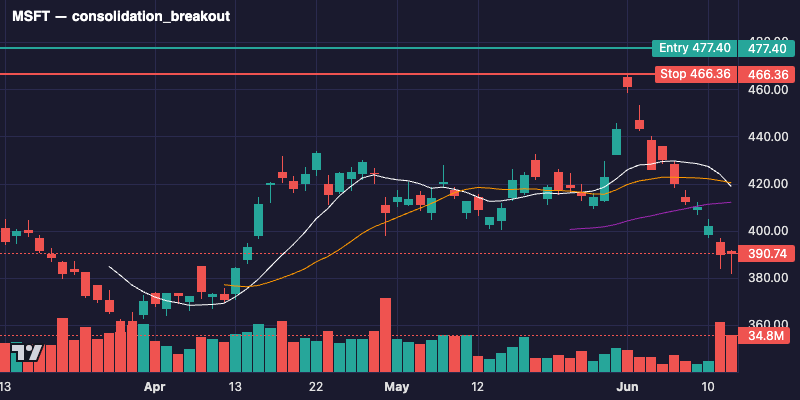
This is where it becomes real. Use /trade add in PaperEdge to log:
- Ticker — what you're trading
- Entry price — where you're getting in
- Stop loss — where you're wrong (define this BEFORE you enter)
- Target — where you'll take profit
- Setup type — what pattern triggered this trade
Writing it down forces clarity. If you can't fill in every field, you don't have a trade — you have a guess.
Step 6: Set your alert
Set a price alert at your stop loss and at your target. This removes emotion from the equation. You've made your decision with a clear head. Now let the market come to you.
Don't sit and watch the candle move. That's how discipline breaks down.
Step 7: Monitor (not stare)
Check once in the morning. Check once in the afternoon. That's it.
Ask yourself: Has anything changed about why I entered this trade? Is the regime still the same? Has volume dried up or exploded? Is the stock acting as expected?
If the answer is "everything looks normal" — do nothing. The best trades require the least intervention.
Step 8: Close the trade
Either your stop was hit, your target was hit, or conditions changed enough to warrant an early exit. Log the result. Note what happened.
No trade is a failure if you followed your process. A loss with discipline is worth more than a win from luck.
What to track over your first 20 trades
Twenty trades is the minimum sample size where patterns in your behavior start to emerge. Here's what to record for each:
- Setup type — What pattern did you trade?
- Regime at entry — What was the market environment?
- Result — Win, loss, or breakeven?
- R-multiple — How much did you make or lose relative to your risk?
- Notes — What did you notice? What surprised you?
After 20 trades, look for your own patterns:
- Which setup type works best for you?
- Do you perform better in certain regimes?
- Are you cutting winners too early or letting losers run?
- Are your stops in the right place, or do you get stopped out just before the move?
This data is worth more than any course, book, or guru. It's your personal trading fingerprint.
When to go live
You're ready for real money when three things are true:
1. You have a positive expectancy over 20+ trades. Not every trade wins — but on average, your winners outweigh your losers. If your average win is 2R and your win rate is 40%, you're making money over time.
2. You can follow your rules without emotional override. When you see a stop about to get hit, do you move it? When a stock rips 5% in a day, do you chase? If paper trading showed you these tendencies, good. Now you know what to work on.
3. You're bored. This sounds strange, but it's the clearest signal. When paper trading becomes mechanical — when you stop feeling excitement on entries and dread on losses — you've internalized the process. The emotions have faded into routine. That's when you're ready.
If you're not there yet, stay with paper. There's no rush. The market will be here tomorrow, next month, next year. Patience in this phase saves you thousands later.
Try it yourself
Place your first paper trade today using /trade add. Pick one signal from the PaperEdge channel. Walk through all eight steps above. Log it. Set your alerts. Then walk away and let it play out.
One trade. That's all. Start the counter toward 20.
You've completed the PaperEdge foundation course.
You now have a systematic framework for finding, evaluating, and managing trades. You know how to read candles, understand price movement, interpret financial data, decode options activity, read VIX, assess relative strength, identify market regime, spot consolidation breakouts, recognize trend pullbacks, and execute a complete trade from signal to close.
That's not a collection of random facts. That's a decision-making system.
Most traders never build one. They jump from indicator to indicator, strategy to strategy, guru to guru — always searching for the magic signal. You now know the truth: there is no magic signal. There's only a repeatable process, applied with discipline, over time.
PaperEdge tracks all of this automatically — join free to follow along.